Among all North American and European wildlife, few anatomical features are as instantly recognizable—or as widely misunderstood—as the paddle-shaped tail of the beaver. While many casual observers assume this leathery appendage is merely a swimming paddle, evolutionary biologists consider it one of nature’s most sophisticated multi-tools.
So, why do beavers have flat tails? Far from being a simple swimming aid, a beaver’s tail functions as an underwater steering rudder, a dynamic balance tripod on dry land, an acoustic alarm system, an energy storage bank, and an internal thermostat.
Understanding how this singular adaptation works reveals why beavers are among the most capable semi-aquatic engineers on Earth.
1. The Dynamic Underwater Rudder
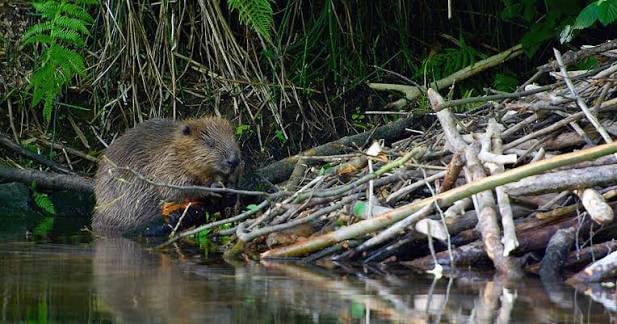
Contrary to a widespread myth, beavers do not propel themselves through the water by flapping their tails up and down like dolphins. Their primary forward propulsion comes from their large, webbed hind feet.
Instead, the flat, horizontally oriented tail acts as a hydrodynamic rudder and elevator:
- Precise Steering: By tilting the broad surface of the tail, a beaver navigates complex underwater obstacle courses filled with submerged logs, root systems, and tunnel entrances.
- Counteracting Buoyancy: Beavers carry heavy tree limbs in their jaws while swimming. Without a counterweight, the weight of the timber would force their heads underwater. Tilting the broad tail counterbalances this forward drag, keeping their nostrils and eyes above the waterline.
- Rapid Diving: A swift upward flip of the tail allows the beaver to execute sudden emergency dives to escape shoreline predators like coyotes, wolves, and eagles.
2. A Living Kickstand for Felling Massive Trees
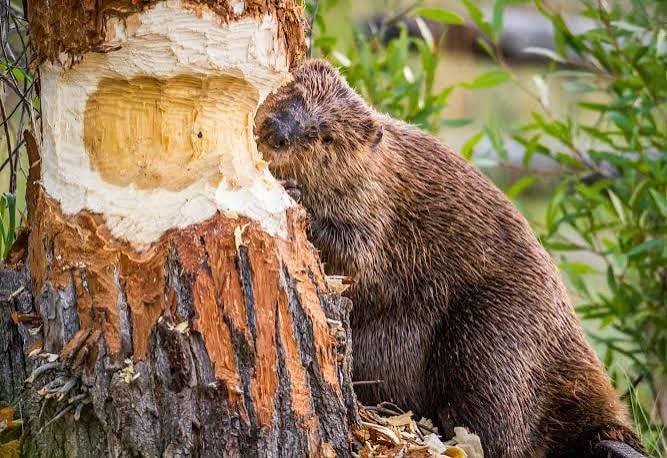
Beavers spend considerable time on land harvesting heavy timber, including aspen, birch, and willow. Chewing through a mature tree trunk requires immense physical leverage, muscle stability, and endurance.
When a beaver rears up on its hind legs to gnaw at bark, the tail functions as a sturdy third leg, forming a stable tripod:
- It supports body weight while the animal uses both forepaws to manipulate branches.
- It absorbs the mechanical vibration and recoil generated by powerful jaw muscles gnawing against dense hardwood.
- When hauling timber back to the riverbank, the flat surface drags along the soil, steadying the beaver against steep river embankments.
3. Acoustic Warning System: The Signature “Tail Slap”
Communication within a beaver colony is essential for collective defense. Living in semi-aquatic habitats where sightlines are frequently blocked by reeds and thick forest canopies, beavers rely on sound to broadcast danger.
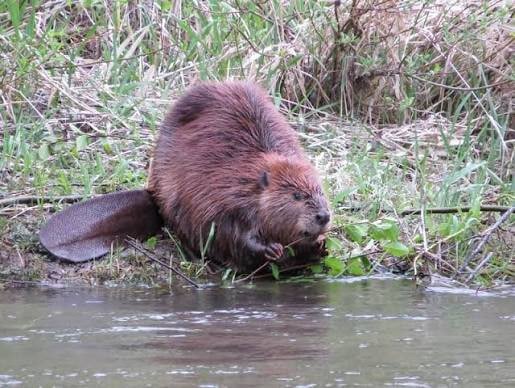
When a predator approaches, a sentry beaver raises its tail and slaps it forcefully against the water’s surface:
- Loud Resonating Blast: The flat surface area creates a sharp, echoing crack resembling a gunshot.
- Dual Signal: The impact produces both an airborne sound wave that alerts family members feeding on land and an underwater acoustic shockwave felt by diving kits.
- Immediate Response: Upon hearing the slap, the entire colony retreats inside the submerged chambers of their predator-proof lodge.
4. Subcutaneous Fat Storage: Surviving Harsh Northern Winters
Beavers do not hibernate. During freezing winters in Canada, Scandinavia, and the northern United States, ponds freeze over under thick ice sheets, trapping the animals in their lodges and water tunnels.
The tail functions as an energy reserve bank:
| Season | Tail Condition | Biological Function |
| Autumn (September–November) | Plump, thick, and swollen | Stores up to 60% of the animal’s subcutaneous body fat |
| Winter (December–February) | Gradually thins out | Metabolizes stored adipose tissue when food caches run low |
| Spring (March–May) | Flat and visibly lean | Depleted reserves reset as fresh spring vegetation emerges |
This biological adaptation ensures that adults and developing yearlings survive extended periods of sub-zero temperatures without starvation.
5. Thermoregulation: An Internal Climate Control Device
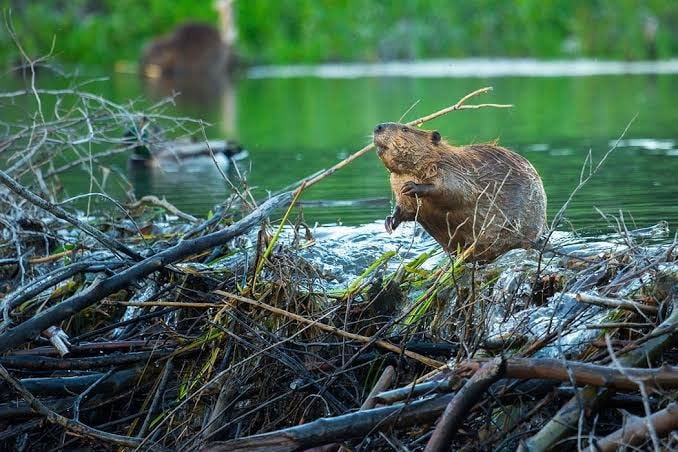
Covered in a layer of scaly, keratinized skin rather than dense fur, the beaver’s tail acts as a vital heat exchanger.
Beavers possess an intricate vascular network known as a counter-current heat exchange system:
- In Freezing Water: Blood vessels in the tail constrict, reducing circulation to the exterior appendage. This prevents icy water from stripping core body heat and protects the vital internal organs from hypothermia.
- During Intense Summer Labor: When felling heavy trees or dragging mud in warm weather, warm blood rushes to the tail. The uninsulated surface radiates excess heat into the air or water, cooling the animal down efficiently.
Conclusion
The flat tail of the beaver is an extraordinary triumph of natural engineering. Far more than an aesthetic oddity, it is an indispensable survival system that makes lifelong dam-building, cold-weather resilience, and predator evasion possible.
By functioning as a rudder, kickstand, alarm bell, food storage locker, and thermostat all at once, the tail empowers beavers to thrive as the undisputed architects of North American and European freshwater ecosystems.