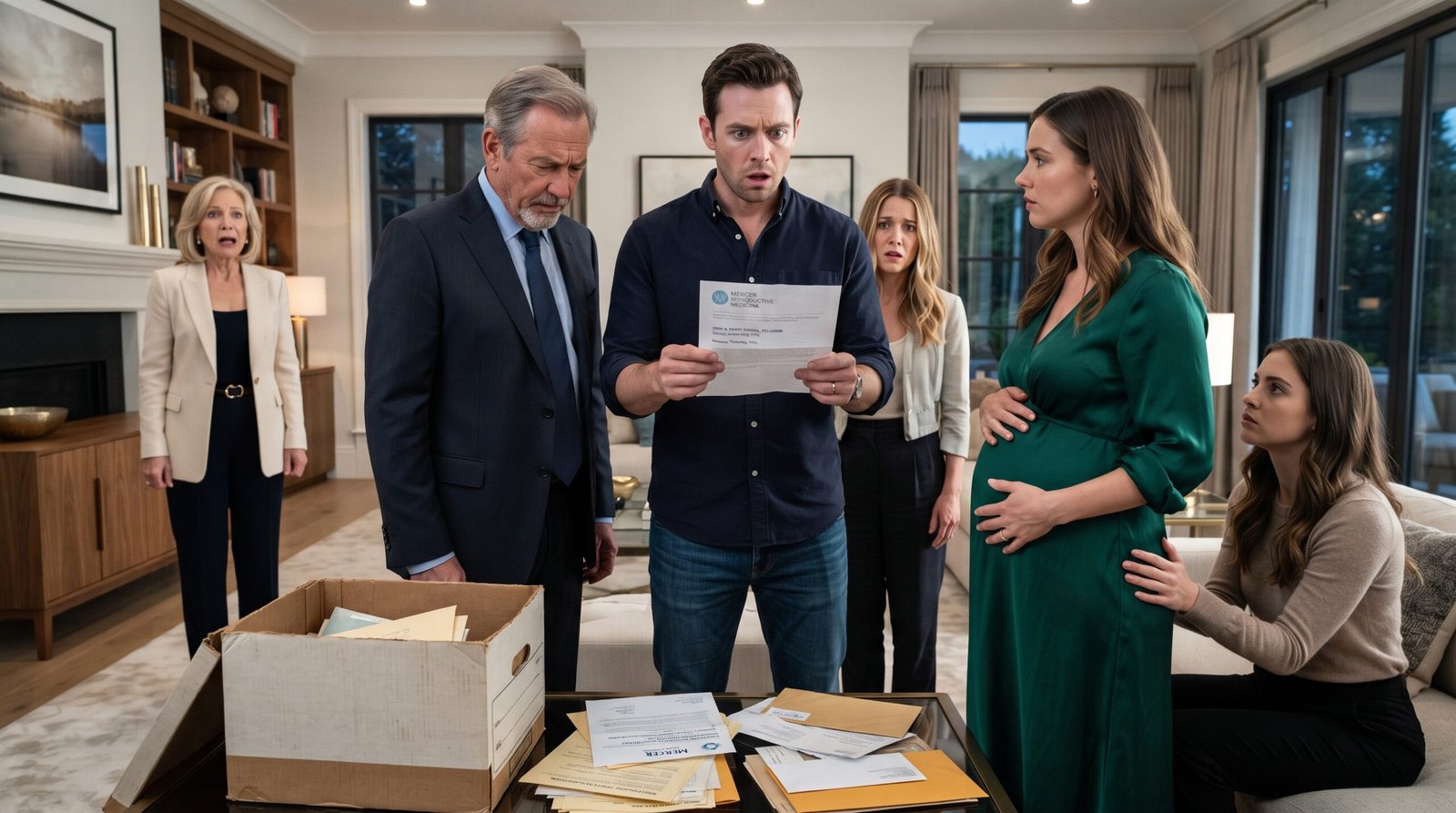
I opened Richard’s letter at my kitchen table.
Not in a law office.
Not at the Vance estate.
Not beneath portraits of people whose names had been carved into buildings.
At my little secondhand table with a sleeping baby in the next room and a mug of tea going cold beside me.
Julian sat across from me.
Dr.
Mercer was beside him.
Eleanor had chosen not to come.
“I think this belongs to you first,” she had said.
Perhaps that was the first boundary she had ever willingly respected.
The envelope opened with a soft tear.
Inside were six handwritten pages.
Richard’s handwriting had deteriorated near the end of his illness, but the first page was clear.
Dear Vivian,
If you are reading this, then you have become a mother.
I stopped.
Julian lowered his gaze.
I continued.
I hope the child is healthy.
I hope Julian has discovered that becoming responsible for another person is not the loss of freedom he has always feared, but the beginning of a different kind of freedom.
Julian exhaled.
“That sounds like him.”
I smiled faintly.
It did.
The letter continued.
Richard wrote that he had watched Julian become increasingly dependent on Eleanor’s judgment after entering the family business.
He loved Eleanor, he explained, but understood her fear of instability.
He had spent a lifetime trying to soften that fear without humiliating her.
Then came the sentence that changed everything.
Several years ago, Eleanor finally told me something I had already suspected: she had never told Gabriel Mercer that Julian lived.
Dr.
Mercer closed his eyes.
Richard had known.
Not simply that Julian was not biologically his.
He had known Gabriel believed his child was dead.
I told Eleanor she should correct that wrong.
She refused.
I did not force the truth because Julian was already a grown man and I feared revealing it for him rather than to him would create another wrong.
Dr.
Mercer read the paragraph twice.
Then nodded slowly.
“I understand.”
Julian looked at him.
“You do?”
“I don’t like it.”
Dr.
Mercer folded his hands.
“But understanding someone’s decision is different from agreeing with it.”
I continued reading.
Richard wrote about the family trust.
Its original structure had given Eleanor influence over several companies after his death.
But two years before he died, he amended it.
When Julian had a child, control would gradually shift away from Eleanor—not directly to Julian, as we had assumed, but into an independent family trust benefiting the child and overseen by three trustees.
One of those trustees was me.
I stopped reading.
“What?”
Julian leaned forward.
“Read that again.”
I did.
There it was.
My name.
Vivian Hart Vance.
Daniel confirmed it later that afternoon.
Richard had appointed me because of my auditing background.
He had known I left my career after marrying Julian.
He had also known why.
I remembered one dinner when Richard asked whether I missed working.
I had given the polite answer.
“Sometimes.”
He had looked at me for several seconds before saying, “Sometimes is often another word for yes when people are trying not to make others uncomfortable.”
I had laughed.
Now the memory hurt.
Richard’s letter continued.
Vivian, you may wonder why I chose you.
The answer is uncomplicated.
You notice what others overlook, and you are less impressed by wealth than anyone I have met in this family.
I laughed softly through my tears.
Julian smiled.
“That also sounds like him.”
I have watched you challenge numbers that did not make sense, return gifts you considered excessive, and quietly correct staff members’ payroll errors when no one else noticed.
I remembered all of those things.
I had thought no one noticed.
Richard had.
More importantly, I have watched you love my son without flattering him.
Julian looked away.
The final page was the hardest.
If my grandchild has been born into disagreement, do not allow money to become the loudest voice in the room.
Money is useful.
It can provide safety, education, time, healthcare, and opportunity.
But people begin losing themselves when they confuse control of money with control of one another.
I lowered the letter.
No one spoke.
Richard seemed present in the room.
Not as a ghost.
As a memory strong enough to influence choices even after death.
The letter ended simply.
Make a life you respect.
Give the child room to become himself.
And when possible, leave every room kinder than you found it.
Richard.
I pressed the pages against the table.
For months I had imagined justice as exposure.
A courtroom.
Documents presented.
People finally understanding exactly what Julian and Eleanor had done.
Richard’s letter showed me something more difficult.
Justice mattered.
Boundaries mattered.
Consequences mattered.
But after those things came choices.
What kind of life did I actually want?
Julian remained quiet for a long time.
Finally he said, “I’m ashamed of how I treated you.”
I looked at him.
“I know.”
“No.”
He shook his head.
“I don’t think you do.”
He stared toward the window.
“I let my fear become someone else’s suffering.
I was afraid of becoming a father.
Afraid of losing control of the company.
Afraid my mother would think I had chosen you over the family.”
He gave a small, tired laugh.
“And then I behaved in a way that nearly cost me all three.”
“You did.”
He nodded.
“I’m not going to ask you to forgive me because I’ve apologized.”
“Good.”
“I’m going to try to become someone you might forgive eventually.”
That distinction mattered.
I folded Richard’s letter carefully.
“What does that mean?”
“For one thing, the divorce proceeds on fair terms.”
My chest tightened slightly.
Even after everything, hearing the word divorce hurt.
Julian saw it.
“So we are divorcing,” I said.
“I think we should.”
I had expected to be the one saying it.
“Why?”
“Because I don’t want our old marriage back.”
His voice was steady.
“Neither should you.”
I stared at him.
“A marriage where I depended on my mother to make decisions.
Where you gave up pieces of yourself to avoid conflict.
Where we confused comfort with happiness.”
He looked toward Noah’s room.
“If we ever become anything to each other again, I want it to be because we choose it from the beginning.”
Something loosened inside me.
Not disappointment.
Relief.
I did not need to decide my whole future that afternoon.
Neither did he.
For once, we could simply tell the truth.
The divorce settlement was completed six weeks later.
There was no dramatic courtroom battle.
Daniel helped Julian disclose everything voluntarily.
I hired my own lawyer.
Julian restored the marital funds that had been withheld and covered the medical expenses I had paid during the separation.
I kept my apartment.
I also returned to work.
Not cleaning offices.
Not folding hotel towels.
Auditing.
A former colleague heard I was available and offered me a flexible contract.
The first morning I opened a financial report with Noah sleeping beside my desk, I felt something I had not felt for years.
Recognition.
There you are, I thought.
I had missed myself.
Julian began visiting Noah three evenings each week.
At first I stayed in the room.
He learned bottles.
Diapers.
The particular bouncing rhythm Noah liked when he was tired.
He learned that babies did not care about conference calls.
One evening I came into the living room and found Julian whispering seriously to our eight-week-old son.
“You cannot schedule a digestive emergency during a board meeting.”
Noah smiled.
Julian stared.
“Vivian.”
“What?”
“He smiled.”
“He’s been doing that for a week.”
“Not at me.”
He looked ridiculously pleased.
That became the photograph I kept.
Not Julian in a suit.
Not Julian standing beside the Vance Foundation building.
Julian sitting on my cheap living-room rug while Noah grabbed his finger.
Dr.
Mercer entered our lives carefully.
He never called himself Grandfather without permission.
For the first few months, Noah knew him simply as Gabriel.
Julian met him for coffee.
Then lunch.
Eventually dinner.
Their conversations were awkward at first.
They had thirty-five years of questions and no graceful order for asking them.
“What was your first car?”
“Did you play sports?”
“What did my grandparents know?”
“Why did you become a doctor?”
Ordinary questions.
That was what made them painful and beautiful.
They were building a relationship backward.
One missing year at a time.
Eleanor had the hardest road.
For several months Julian spoke to her only when necessary.
She resigned from her controlling position in the foundation voluntarily.
The decision surprised everyone.
She also began seeing a counselor.
I knew because she told me herself.
Not as a defense.
As a fact.
One Saturday afternoon, when Noah was almost four months old, she came to my apartment.
She stood at the door holding nothing.
No flowers.
No expensive baby gift.
No attempt to buy her way into the room.
“May I come in?”
I hesitated.
Then stepped aside.
She sat on the sofa.
Noah slept in his crib.
For several minutes Eleanor simply looked around.
“This apartment is peaceful.”
“It usually isn’t when Noah is awake.”
She smiled.
Then the smile disappeared.
“I owe you an apology that doesn’t contain an explanation.”
I waited.
“I treated you badly.”
Her voice trembled.
“I lied about you.
I interfered with your finances.
I convinced myself that protecting Julian justified almost anything.”
She looked at her hands.
“It didn’t.”
“No.”
“I also believed becoming a grandmother gave me rights I hadn’t earned.”
I studied her.
“That’s true.”
She nodded.
“I know.”
There was no argument.
No performance.
Just acceptance.
“I don’t expect you to trust me.”
Those words sounded familiar.
Julian had once said the same thing.
Eleanor looked toward Noah’s room.
“I would like, someday, to be someone you trust around him.”
I thought carefully before answering.
“Someday is possible.”
Her eyes filled.
“Thank you.”
“I didn’t say today.”
A tiny smile appeared.
“No.”
She stood.
“I understand.”
Before leaving, she paused.
“Vivian?”
“Yes?”
“Gabriel told me he forgives me.”
I said nothing.
“I don’t think he means what I used to think forgiveness meant.”
“What did you think it meant?”
“That things return to normal.”
I shook my head.
“Sometimes forgiveness means accepting that normal is gone.”
She nodded slowly.
“Yes.”
Six months passed.
Then a year.
The first birthday celebration we held for Noah would once have seemed impossible.
Mara decorated my backyard with paper stars.
Dr.
Mercer brought a wooden train.
Eleanor brought one book.
Just one.
Inside she had written:
For Noah—may you always know that love should give you room to grow.
Julian arrived late because he had stopped to buy ice.
He had forgotten it twice.
“Do not say anything,” he warned when he saw me smiling.
“I didn’t.”
“You were about to.”
“I was going to ask whether the great Julian Vance had finally discovered grocery stores.”
“Very funny.”
Our divorce had been final for nearly ten months.
Somewhere in those months, something unexpected happened.
We became friends.
Not because we pretended the past had never happened.
Because we stopped pretending about everything else.
He told me when he was afraid.
I told him when I was angry.
He stopped trying to solve every problem with money.
I stopped swallowing words to maintain peace.
Sometimes Noah fell asleep after Julian’s visits and Julian stayed for coffee.
Those coffees became dinners.
Those dinners became walks.
No promises.
No rushing.
One evening, after putting Noah to bed, we sat on the back steps while summer insects hummed in the dark.
Julian looked toward the kitchen window.
“I miss this.”
“What?”
“You.”
My heart tightened.
He continued before I could answer.
“I know missing something doesn’t mean I deserve it back.”
I looked at him.
A year earlier those words would have been impossible for him.
“What do you miss?”
He smiled.
“The way you argue with television documentaries.”
“They get facts wrong.”
“Of course.”
“The way you steal the crispy potatoes.”
“You always leave them.”
“Because you steal them.”
I laughed.
Then he became serious.
“I miss having a life with you.”
I looked down at my hands.
“We had a life before.”
“We had an arrangement we called a life.”
That hurt because it was true.
He turned toward me.
“I’m not asking you to remarry me.”
“Good.”
“I’m asking whether I can take you to dinner.”
I stared at him.
“We eat dinner together every Thursday.”
“A different dinner.”
I smiled despite myself.
“A date?”
“Yes.”
“With your ex-wife?”
“I’ve been told she’s extremely difficult.”
“She is.”
“I like her better now.”
“So do I.”
The answer came before fear could stop it.
“Yes.”
Julian blinked.
“Yes?”
“One dinner.”
His smile was slow and familiar.
But no longer entitled.
“One dinner.”
It became more than one.
We dated for almost two years.
Slowly.
Deliberately.
No shared bank account.
No moving in after three months.
No grand declarations designed to erase what happened.
Trust returned in ordinary moments.
Julian showing up when he said he would.
Me admitting when something from the past hurt instead of pretending it didn’t.
Both of us learning that forgiveness was not forgetting.
It was remembering without allowing memory to make every future decision.
Dr.
Mercer became Grandpa Gabe.
Eleanor became Grandma Eleanor, though Noah shortened it to “Nora” when he learned to speak, and the name stuck.
Mara remained Aunt Mara despite having no biological relationship to anyone.
“No one is correcting him,” she declared.
No one did.
When Noah was almost three, Julian and I married again.
Not at the Vance estate.
Not in a hotel ballroom.
In Dr.
Mercer’s backyard.
Twenty-seven people attended.
Mara stood beside me.
Daniel somehow became Julian’s best man after claiming he was “absolutely not qualified for emotional responsibilities.”
Eleanor sat beside Dr.
Mercer.
They were not together.
They never became romantic again.
Their relationship settled into something quieter.
Two people sharing history, regret, and affection without pretending time had not passed.
Before the ceremony, Eleanor entered the small bedroom where I was getting ready.
For a moment I expected some memory of our first marriage to rise between us.
Instead she handed me a simple envelope.
Inside was a copy of Richard’s final letter.
“I thought he should be here somehow,” she said.
My eyes filled.
“Thank you.”
She turned to leave.
“Eleanor?”
She looked back.
I crossed the room and hugged her.
She froze.
Then slowly wrapped her arms around me.
Neither of us said forgiveness.
We didn’t need to.
Outside, Noah was trying to convince Grandpa Gabe that cake should be served before lunch.
Julian stood beneath a maple tree waiting for me.
When I reached him, he took my hands.
“No promises about protecting me,” I whispered.
He smiled.
“No.”
“No promises that nothing will ever go wrong.”
“No.”
“Then what are you promising?”
He looked at me with a steadiness he had earned over years rather than moments.
“To tell you the truth.”
I squeezed his hands.
“That’s a good place to start.”
Noah shouted from the front row.
“Daddy!
Kiss Mommy!”
Everyone laughed.
Julian looked at me.
“He’s very demanding.”
“Family trait.”
“Which side?”
“All of them.”
Later, after the guests left, I found Richard’s letter resting beside our wedding flowers.
Make a life you respect.
For years, I believed survival meant holding everything together.
Then I believed strength meant proving I could live without anyone.
Both ideas had contained some truth.
But neither was complete.
Strength was also knowing whom to trust again.
Knowing when an apology had become a pattern of change.
Knowing that forgiveness could coexist with boundaries.
Knowing that family was not defined by blood, money, surnames, or the stories people told to protect appearances.
Family was built through choices repeated until they became a life.
I looked through the window.
Dr.
Mercer was teaching Noah how to balance a wooden train on the porch railing.
Eleanor hovered nearby, wisely resisting the urge to correct either of them.
Mara was stealing leftover cake.
Julian was searching for something in the kitchen.
“What did you lose?”
I asked.
“My keys.”
“They’re in your pocket.”
He checked.
“They are.”
“Some things never change.”
He came toward me.
“Some things should.”
He kissed my forehead.
Outside, Noah called for us.
We walked toward him together.
Not because the past had disappeared.
Not because every wound had healed perfectly.
Not because anyone had received the life they once expected.
We walked together because, after all the secrets, mistakes, apologies, and second chances, we had finally learned something Richard had understood long before the rest of us.
A good family was not one without broken places.
It was one where people eventually stopped hiding them.
And somehow, from the morning I had driven myself to the hospital believing I had no one, my life had become full.
Full of difficult truth.
Full of unexpected family.
Full of work I loved.
Full of a little boy whose arrival had uncovered thirty-five years of secrets.
And full of a second chance I had accepted only after learning I could walk away from it.
Julian opened the back door.
Noah ran toward us with both arms raised.
“Mommy!
Daddy!
Come!”
So we did.
Together.
By choice.
And this time, that made all the difference.
– END OF PART 4 – LET SAY YES AND LIKE, SHARE THIS POST IN FACEBOOK SO THAT WE HAVE THE MOTIVATION TO SHARE MORE STORIES