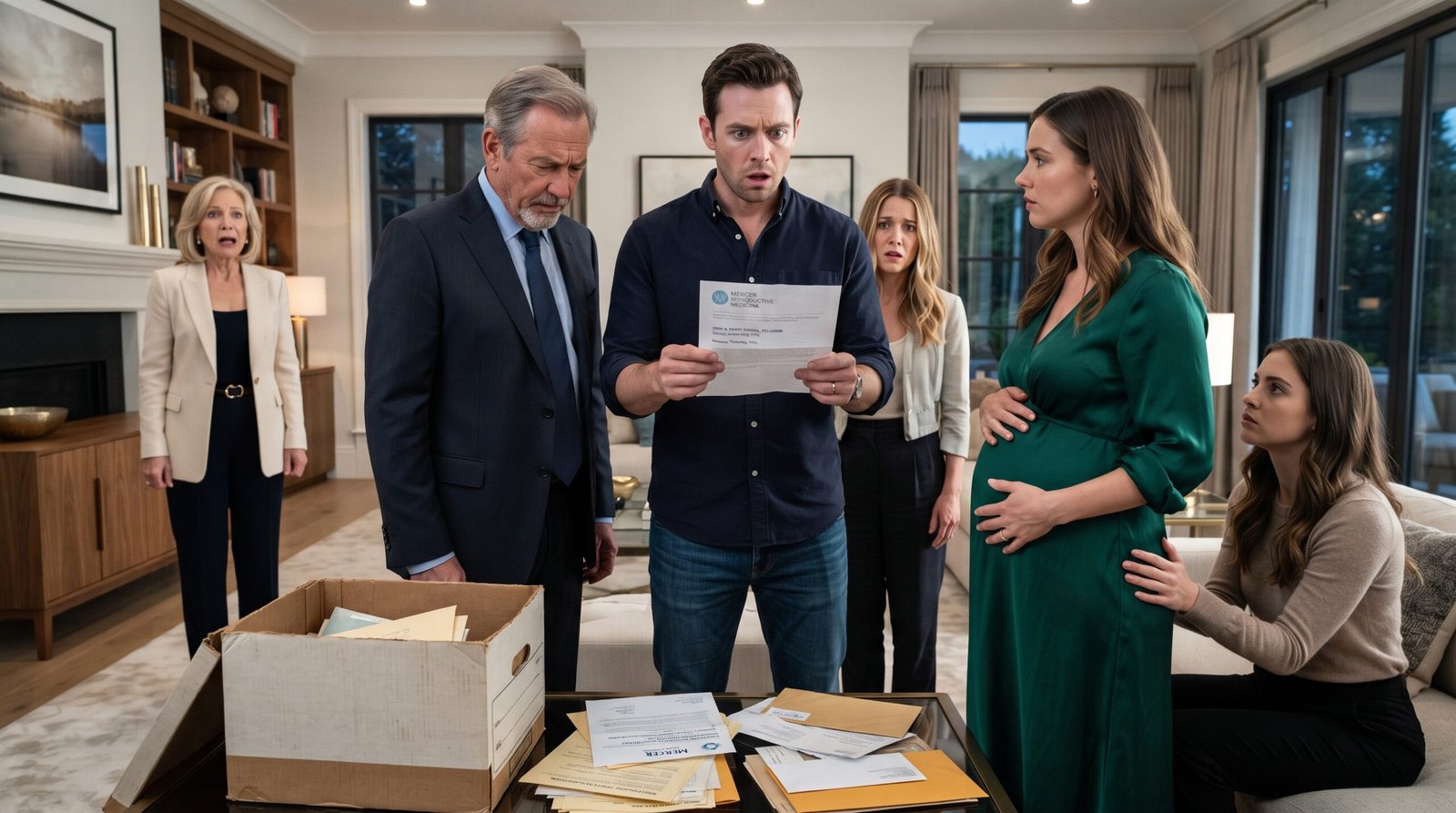
No one moved.
The letter trembled slightly in Leo’s hand.
Liam looked from the paper to Evelyn.
“What truth?”
Evelyn lowered herself into the chair beside the window.
For several seconds she seemed much older than she had the previous day.
“Read the letter first.”
“You put it there?”
“Yes.”
“When?”
“This morning.”
“Why pretend you didn’t know?”
“I didn’t pretend.”
Her eyes moved toward the envelope.
“I recognized the handwriting.
I didn’t know which letter it was.”
Liam stared at her.
“How many are there?”
“Seven.”
That surprised everyone.
Even Leo.
“Seven?”
Liam repeated.
Evelyn nodded.
“Your father wrote them during the final year of his life.”
“He wasn’t sick.”
“No.”
“Then why write goodbye letters?”
“They weren’t goodbye letters.”
She folded her hands.
“They were explanations.”
Liam’s face became unreadable.
Leo offered him the page.
After a moment, Liam took it.
I turned toward the door.
“I’ll give you privacy.”
“No.”
Liam spoke before I had taken two steps.
“Stay.”
I stopped.
It was a small word.
But coming from Liam, it felt important.
So I stayed.
He unfolded the letter.
His eyes moved across the handwriting.
He read silently at first.
Then he stopped.
Started again.
Evelyn waited.
“What does it say?”
Leo finally asked.
Liam’s voice sounded distant.
“He knew.”
“Knew what?”
I asked.
Liam looked toward his aunt.
“That I blamed myself.”
Evelyn’s expression softened.
Liam continued reading aloud.
“‘You have always believed responsibility means carrying every consequence alone.
I taught you that without realizing the harm in it.’”
He paused.
His throat worked.
Then he continued.
“‘If anything ever happens to me, or to Anna, I need you to remember that loving someone does not give you control over every road they choose.’”
His voice failed briefly.
Evelyn stood.
Liam shook his head.
“Don’t.”
She remained where she was.
He finished silently.
When he reached the bottom, he stared at the page for nearly a minute.
“What happened at the lake house?”
I asked gently.
This time Liam answered.
“My father and Anna drove into town.”
Evelyn added quietly, “There was freezing rain.”
Liam nodded.
“I told them to wait.”
His fingers tightened around the letter.
“Anna wanted to go anyway.
She had an interview.”
“For what?”
I asked.
“A scholarship program in Boston.”
A faint smile touched his face.
“She wanted to become an architect.”
He looked out at the bench.
“My father offered to drive.”
I understood before he said the rest.
“You blamed yourself because you didn’t stop them.”
“I’d been arguing with Anna.”
He spoke carefully, as if each word had to pass through years of resistance.
“She wanted to leave the family company.
My father thought she should.
I thought she was making a mistake.”
Evelyn said, “You were twenty-seven.”
“I was arrogant.”
“You were her brother.”
“I told her if she left, she shouldn’t expect me to fix things when she failed.”
He looked down.
“That was the last thing I said to her.”
No one rushed to tell him it wasn’t his fault.
I was grateful for that.
Grief rarely surrendered because someone presented it with logic.
Finally I asked, “And the blinds?”
“The hospital released me from the accident investigation office late that night.”
I frowned.
“You weren’t in the car?”
“No.”
“You said the accident was at the lake house.”
“It happened on the road leaving it.”
He looked toward the garden.
“I came home the next morning.
That bench was the first thing I saw.”
Understanding settled slowly.
“So you closed the blinds.”
“And never opened them again.”
Five years.
Five years of turning one room into winter.
Evelyn sat again.
“Your father had given me the letters months earlier.”
Liam looked at her.
“And you kept them.”
“Yes.”
“Why?”
“Because his instructions were specific.”
She reached into her handbag and removed a small notebook.
“He told me not to give them to you while you were still trying to manage grief like another company.”
Liam gave a humorless laugh.
“That sounds like him.”
“There was another condition.”
“What?”
“You had to ask for help without treating it as defeat.”
Liam’s gaze moved to me.
I remembered the previous morning.
Stay.
Perhaps Evelyn remembered too.
“That’s absurd,” Liam said.
“It probably is.”
She smiled sadly.
“Your father enjoyed dramatic instructions.”
Leo murmured, “Runs in the family.”
Liam looked at him.
Leo suddenly became fascinated by the carpet.
Despite everything, a laugh escaped me.
Then Evelyn laughed.
Finally, astonishingly, Liam did too.
It lasted only seconds.
But the room felt different afterward.
The letter did not repair five years.
It did something quieter.
It opened a door.
Over the next several days, Liam asked Evelyn for the other letters.
She refused.
Naturally, he reacted exactly as expected.
“They belong to me.”
“Eventually.”
“I can have Leo open your safe.”
Leo immediately said, “Please leave me out of family disputes.”
Evelyn continued drinking tea.
“Your father wrote instructions for each.”
“This is ridiculous.”
“Yes.”
“I am forty-two years old.”
“And sulking because your aunt won’t give you your mail.”
I covered my smile with my clipboard.
Liam pointed at me.
“Not one word.”
“I’m documenting neurological improvement.”
He narrowed his eyes.
“What does that mean?”
“Patient demonstrates ability to complain with increased energy.”
Even Evelyn nearly spilled her tea.
The next letter came after Liam completed his first assisted standing session.
The third arrived after he permitted Dr.
Chen to reduce one of his medications without arguing for twenty minutes.
The letters weren’t rewards.
I slowly understood that.
They were milestones.
His father had somehow anticipated the stages Liam would need to pass through.
One concerned responsibility.
Another concerned Anna.
A third concerned the Mercer Foundation, which I learned Liam had nearly closed after the accident because it had been his father’s project.
The fourth was simply a story.
Daniel Mercer described Liam at nine years old trying to rescue an injured bird.
“You hid it in your closet,” Evelyn told him.
“It died.”
“After eating half my curtains.”
Liam looked at me.
“It was a destructive bird.”
“You kept a wild bird in a bedroom?”
“I was nine.”
“Apparently questionable judgment started early.”
He rolled his eyes.
Something else was changing too.
My relationship with him had become easier.
Not simple.
Liam Mercer would probably never qualify as simple.
But real.
He asked about Tommy without trying to solve anything.
That mattered.
“How old is he?”
Liam asked one evening.
“Twenty.”
“What does he study?”
“Mechanical engineering.”
“Good field.”
“He likes taking things apart.”
“Can he put them back together?”
“Rarely.”
A small smile.
“How is he?”
I looked at the IV pump rather than Liam.
“His counts are stable.”
“That wasn’t what I asked.”
“No.”
I sighed.
“He’s scared.”
“And you?”
“I’m the older sister.”
“That also wasn’t what I asked.”
I looked at him.
“I’m terrified.”
Saying it aloud felt strange.
For weeks I had avoided that sentence.
Not because it wasn’t true.
Because admitting fear felt dangerously close to surrender.
Liam nodded.
“Thank you.”
“For what?”
“For answering.”
That night I understood something uncomfortable.
Liam and I were alike in the worst possible way.
We both believed love meant standing between someone else and every bad outcome.
We both treated helplessness as a personal failure.
The difference was that Liam had already spent five years discovering what that belief could cost.
A week later, Dr.
Shah called again.
The hospital had found another funding source.
Not enough.
But enough to reduce the uncovered costs to eighty-five thousand dollars.
I sat at the desk in Liam’s room doing calculations.
Eight and a half weeks.
Possibly seven if I used savings.
Maybe six if I sold my car.
Liam watched me.
“You’re doing math aggressively.”
“That is not a thing.”
“You’ve stabbed the calculator button twelve times.”
“I dislike that particular number.”
He waited.
I finally told him.
“Eighty-five thousand.”
His expression remained neutral.
“Better than two hundred forty.”
“Yes.”
“When does Tommy need it?”
“Before the protocol begins.”
“When?”
“Twelve days.”
His eyes shifted to the papers.
“You won’t earn it here in twelve days.”
“I know.”
“What are you going to do?”
“I’ll find another way.”
“What way?”
“I don’t know yet.”
He did not offer money.
That surprised me.
And strangely, I was grateful.
Instead he asked, “Does the hospital have a charitable funding board?”
“Yes.”
“Have you applied?”
“Three times.”
“Rejected?”
“Wait-listed.”
“Why?”
“Limited funds.”
He thought for a moment.
“What about the Mercer Foundation?”
I stared at him.
“No.”
“You haven’t even heard the question.”
“I know where this is going.”
“You don’t.”
“You want your foundation to pay.”
“I was going to ask whether St.
Matthew’s accepts grants from outside organizations.”
“That is the same thing in a nicer suit.”
Liam smiled faintly.
“Probably.”
“I can’t let you create a special exception.”
“Then don’t.”
I frowned.
He continued.
“Apply normally.”
“Liam.”
“The foundation funds medical access programs.”
“You own it.”
“I chair it.”
“You control it.”
“I don’t.”
I gave him a look.
“Clara, there are eleven trustees.
Applications are reviewed anonymously by an independent committee.”
“Why anonymously?”
“Because my father believed rich people become insufferable when they think gratitude is part of philanthropy.”
That sounded exactly like the man whose letters I had begun to know.
“What happens if they know Tommy is my brother?”
“They won’t.”
“And you?”
“I won’t participate.”
“You’d recuse yourself?”
“Yes.”
“Completely?”
“Yes.”
I studied him.
This was different from offering me a check.
It gave me a path without creating a debt to him personally.
“I’ll think about it.”
“Good.”
“That doesn’t mean yes.”
“I understand how thinking works.”
“Do you?”
“Occasionally.”
Two days later, I submitted the application.
Not because Liam persuaded me.
Because Tommy did.
I had been allowed a supervised video call using the house office.
He appeared on-screen wearing a knit cap and an expression of outrage.
“You’re being stupid.”
“Tommy.”
“You told me to apply for every scholarship in high school.”
“That was different.”
“How?”
“They were scholarships.”
“This is medical aid.”
“Exactly.”
“I don’t want special treatment.”
“Neither did I when Mrs.
Carroll gave us groceries after Dad died.”
I went quiet.
Tommy softened.
“Clara, accepting help doesn’t make us someone else’s project.”
I looked away.
“When did you become wise?”
“Chemotherapy.
Terrible hobby.
Excellent perspective.”
I laughed, then immediately cried.
Not dramatically.
Just two silent tears I wiped away before he could make a joke about them.
After the call, I returned to Liam’s room.
He was sitting in the chair by the open window now.
Not the garden.
Not yet.
But close.
“You applied?” he asked.
“Yes.”
“Good.”
“My brother thinks I’m stubborn.”
“He sounds intelligent.”
“I told him you’re worse.”
“That was unnecessary.”
The following week brought another milestone.
Liam walked.
Only six steps.
He used a specialized frame, Dr.
Chen supported one side, and I stayed near the other.
But he walked.
One.
Two.
Three.
His face tightened with pain.
“Enough,” I said.
“No.”
“Liam.”
“Two more.”
“Four.”
He glared at me.
“Three.”
“You negotiate medical orders now?”
“Three.”
He took three.
Then collapsed into the chair, breathing hard.
For nearly a minute nobody spoke.
Finally Leo said, “Seven steps.”
Liam looked at me.
“You said six.”
“You’re welcome.”
Later that evening Evelyn arrived carrying another letter.
The fifth.
Liam opened it immediately.
This one took longer to read.
His expression changed halfway through.
“What?”
Evelyn asked.
He handed her the page.
She read.
Then looked at him in surprise.
“What does it say?”
I asked.
Liam looked toward the window.
“My father was planning to leave control of the foundation to Anna.”
I said nothing.
“She didn’t want the company,” he continued.
“She wanted the foundation.”
Evelyn nodded slowly.
“That makes sense.”
“It doesn’t.”
“Why?”
“Because I spent five years preserving the wrong thing.”
His voice was quiet.
“I kept the company exactly as he left it because I thought that was how I honored them.”
“And now?”
He looked at the garden.
“Maybe they wanted something else preserved.”
That question seemed to follow him for days.
He began reviewing foundation reports.
Not obsessively.
Curiously.
He asked about programs Anna had supported.
Architecture scholarships.
Community housing.
Rural clinics.
A mentorship program for teenagers who had lost parents.
That one silenced him for a long time.
Meanwhile Tommy’s application remained pending.
Three days passed.
Then five.
Then seven.
His treatment start date was approaching.
I tried not to refresh the portal every ten minutes.
On the eighth morning, Leo entered Liam’s room carrying a sealed envelope.
He gave it to me.
“What is this?”
“Courier delivery.”
My name was printed on the front.
I tore it open.
St.
Matthew’s logo.
My heart stopped.
Then started too quickly.
I read the first paragraph.
Read it again.
Liam watched me.
“Clara?”
I couldn’t speak.
I handed him the paper.
He read.
The Mercer Foundation had approved Tommy’s remaining treatment costs.
All eighty-five thousand dollars.
Plus transportation and follow-up care for one year.
I sat down.
For several seconds I simply stared at my hands.
Liam placed the letter on the table.
“I wasn’t involved.”
“I know.”
“I didn’t contact them.”
“I know.”
“I asked Evelyn yesterday.
She confirmed the committee never received your name.
Applications were coded.”
I nodded.
Then I began crying.
Quietly.
Embarrassingly.
Completely.
Liam looked alarmed.
“You’re crying.”
“Yes.”
“Should I get someone?”
Despite myself, I laughed.
“No.”
“I’m serious.”
“I know.”
He looked utterly helpless.
For a man who had faced broken bones and major surgery with gritted teeth, a crying nurse seemed to be his greatest challenge.
I wiped my face.
“My brother gets treatment.”
“Yes.”
“He gets treatment.”
“Yes.”
I stood.
Without thinking, I hugged him.
For half a second Liam froze.
So did I.
Then one arm slowly came around my back.
Not possessive.
Not dramatic.
Just careful.
Human.
“Thank you,” I whispered.
“It wasn’t me.”
“I know.”
That was precisely why I could say it.
The foundation had helped Tommy without turning help into obligation.
Later, after I calmed down, Evelyn found me in the garden.
I had finally convinced Liam to attempt going outside the following morning.
She stood beside the blue bench.
“Anna painted this three times.”
“Liam said blue once.”
“The first blue was too gray.”
I smiled.
“Sounds like she knew what she wanted.”
“She did.”
Evelyn ran one hand along the weathered wood.
“Liam loved that about her until her choices disagreed with his.”
“That sounds familiar.”
“You’ve noticed.”
We stood quietly.
Then Evelyn said, “There’s something you should know.”
I looked at her.
“About Liam’s injuries.”
My stomach tightened.
“You said the accident that killed his family was five years ago.”
“Yes.”
“But these injuries are recent.”
“Yes.”
“What happened?”
Evelyn hesitated.
“The official version is that his car went off a service road during heavy rain.”
“And the unofficial version?”
“He had gone to the old lake property.”
“Why?”
“That’s the question.”
She looked toward the mansion.
“He hadn’t been there since Daniel and Anna died.”
A chill passed through me despite the warm afternoon.
“Did he remember going?”
“Yes.”
“Did he tell you why?”
“No.”
The next morning, Liam made it to the garden.
Leo arranged a wheelchair because walking the entire distance was impossible.
Liam protested.
I ignored him.
When we reached the blue bench, he stared at it for a long time.
Then he laughed softly.
“What?”
“The paint really is awful.”
I sat beside him.
“Your sister might disagree.”
“She usually did.”
Sunlight filtered through the maple leaves.
For once, Liam looked peaceful.
Then he reached beneath the bench.
His fingers stopped.
“What?”
“There’s something here.”
Taped beneath the wooden slat was a small brass key.
Evelyn stared.
“I didn’t put that there.”
Leo examined it.
A faded paper tag was attached with string.
Two words were written on it.
Lake House.
Liam turned the key over in his palm.
His face had gone pale.
“I know this key.”
“How?”
I asked.
He looked at me.
“Because it was in my pocket the night they found me.”
Leo frowned.
“No.
Your pockets were empty.”
Liam’s eyes narrowed.
“That’s impossible.”
“I collected everything from the hospital.”
Liam stared down at the key.
Then something seemed to return to him.
A memory.
“I didn’t drive off that road by accident.”
Every face turned toward him.
He closed his fist around the key.
“I went there because someone sent me a letter.”
Evelyn whispered, “From whom?”
Liam looked toward the trees.
“I thought it was from my father.”
“But your father is dead,” I said gently.
“I know.”
He opened his hand again.
“And the letter said there was something hidden inside the lake house that Anna had never told me.”
He met Evelyn’s eyes.
“Something she had left for me.”
The wind moved through the maple branches.
Five years after Anna Mercer died, it seemed she had one more secret waiting for her brother.
And suddenly the question was no longer why Liam had gone back to the place he feared most.
It was what he had found there.