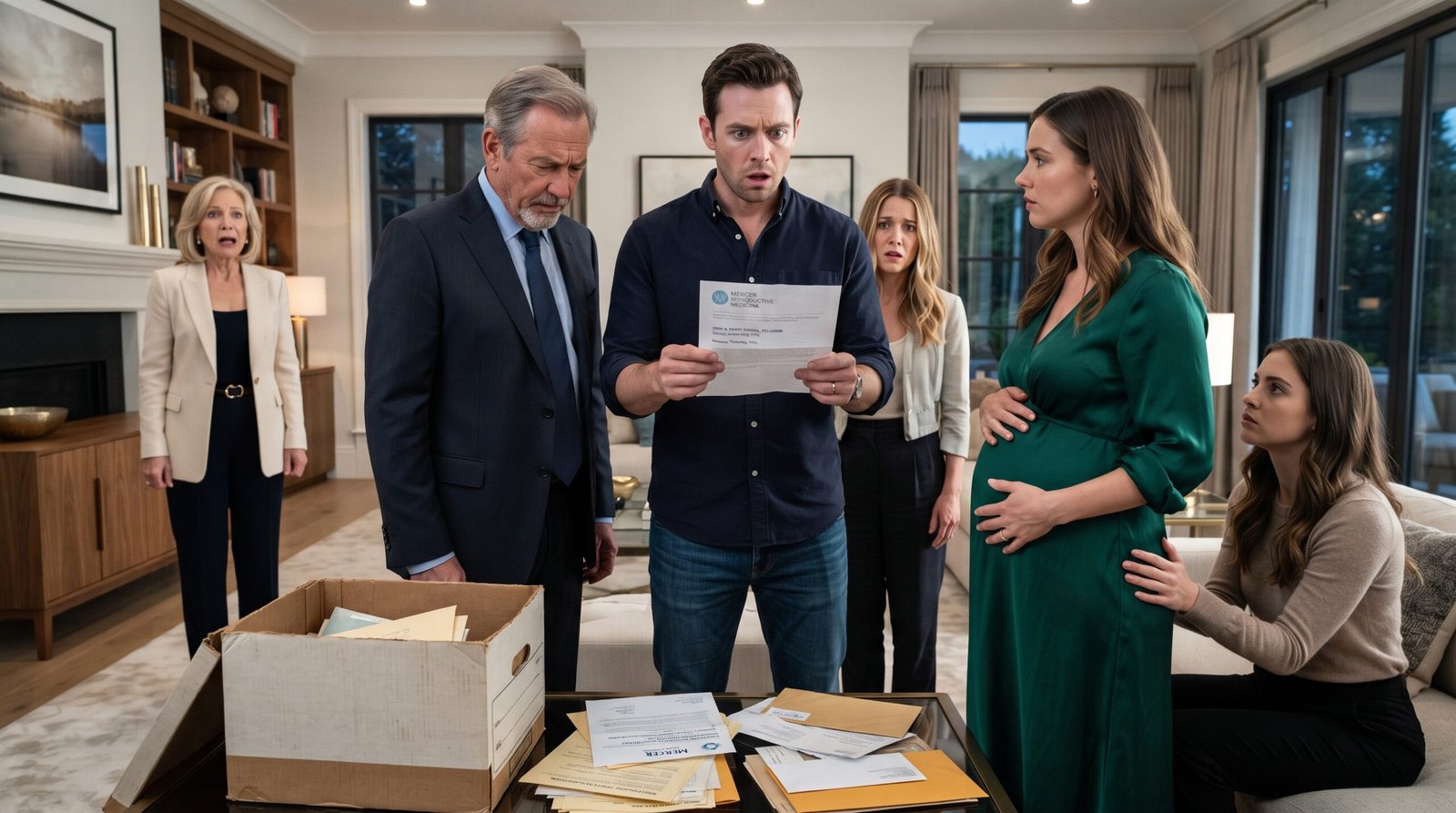
PART 2 — THE LIFE HE ASSUMED WOULD WAIT
I left the hospital two days later wearing the same gray cardigan my mother had brought me the night everything changed.
It hung loosely around me.
The nurse wheeled me through a side entrance because I could not bear the thought of walking through the maternity lobby.
Outside, the September sky was painfully beautiful—clear blue, warm light, eucalyptus leaves shifting in a mild breeze.
The world had continued.
That surprised me.
Cars moved through intersections.
Someone laughed on the sidewalk.
A delivery driver balanced three coffee cups while checking his phone.
Nothing outside the hospital looked different.
Everything inside me was.
My mother, Celeste, drove without turning on the radio.
She had always believed silence should be used carefully.
Growing up, if I was angry or embarrassed, she never filled the room with questions simply because she could not tolerate the quiet.
That morning, I was grateful for it.
We drove north to the house where I had grown up.
My father had bought it before Vale Meridian became successful enough for magazines to photograph our family home.
It was a modest cedar-sided place above the bay, surrounded by rosemary, climbing roses, and three enormous cypress trees.
Julian and I owned a glass-and-stone house forty minutes away.
I did not go there.
My mother had already sent someone for my clothes.
On the dining table, beside a bowl of pears, sat my laptop.
And beneath it was a thick cream envelope.
DIVORCE PETITION—DRAFT.
I stood looking at it.
My mother stopped behind me.
“You don’t have to do anything today.”
“I know.”
“You don’t have to be strong today either.”
“I know.”
She placed her hand gently between my shoulders.
I closed my eyes.
Then I opened them.
“I’m not doing this because I’m strong.”
“No?”
“I’m doing it because I finally understand what staying would cost me.”
My mother said nothing.
She kissed my temple and went into the kitchen.
At ten o’clock, Maya called.
Her voice sounded cautious.
“The board can meet at noon.”
“Everyone?”
“Richard is flying back from Chicago.
He’ll join remotely.
Amina is already at headquarters.
Samuel asked whether Mr.
Vale has been notified.”
I almost laughed.
Not because anything was funny.
Because for five years I had heard people call my husband Mr.
Vale as though the name had always belonged to him.
Julian Mercer had become Julian Vale six months after we married.
He had told me he wanted our family to share one name.
At the time, I had found it romantic.
Now I wondered how many times love had caused me to confuse symbolism with substance.
“Has he been notified?”
I asked.
Maya hesitated.
“I sent him the formal notice.”
“And?”
“No response.”
Of course.
I looked through the window toward the water.
“Proceed.”
At eleven forty-five, I opened my laptop.
My mother set tea beside me.
“You want me here?”
“Yes.”
She sat at the opposite end of the dining room, not close enough to listen deliberately, but close enough that I could look up and know someone was there.
At noon, five faces appeared on my screen.
Amina Patel, Vale Meridian’s chief operating officer.
Richard Chen, our chief financial officer.
Samuel Reyes and Eleanor Grant, both independent directors.
Maya sat at the end of the boardroom table with a legal pad in front of her.
One square remained black.
JULIAN VALE.
Our outside counsel, Margaret Ellis, began the meeting.
“For the record, this is a special meeting of the board of directors of Vale Meridian Holdings.”
My father’s company had begun with twelve employees in a warehouse.
Now it employed almost four thousand people.
For years I had told myself I was preserving my father’s legacy by staying away from daily operations.
I had convinced myself Julian understood business better than I did.
What I had really done was hand him my voice.
Margaret continued.
“The first matter concerns the voting proxy granted by Evelyn Vale as sole trustee of the Vale Family Trust.”
She looked toward the camera.
“Evelyn?”
“I revoke it in full, effective immediately.”
No one spoke.
Margaret nodded.
“The revocation has been executed and filed.”
Amina’s expression remained professional, but I saw something shift in her face.
Not surprise.
Relief.
That frightened me more than surprise would have.
We moved to the second matter.
Julian’s absence.
Not his affair.
Not my marriage.
His absence as chief executive while Vale Meridian was engaged in confidential financing negotiations and preparing for the largest strategic restructuring in its history.
For six days, most senior executives had been unable to reach him except through Chloe Marr.
That was not merely personal irresponsibility.
It was a governance problem.
Then there were the resort expenses.
The corporate bookings.
The undisclosed personal relationship with a senior employee whose department reported indirectly to Julian.
Samuel cleared his throat.
“I want the minutes to reflect that we are not adjudicating anyone’s private life.”
“Agreed,” I said.
“This is about disclosure, expenses, conflicts and availability.”
“Yes.”
A vote was taken.
Julian would be placed on temporary administrative leave pending an independent governance review.
Amina would serve as acting chief executive.
I would assume the previously vacant role of nonexecutive chair until shareholders could consider a permanent arrangement.
Nobody celebrated.
That mattered to me.
This was not revenge.
If I had wanted revenge, I would have wanted Julian sitting in the room when the vote happened.
Instead, I was simply closing doors I should never have left unlocked.
The meeting lasted ninety-three minutes.
Then Richard said, “There is one additional issue.”
He looked uncomfortable.
“What issue?”
“The Meridian Heritage sale.”
I frowned.
“What sale?”
Nobody answered immediately.
I looked from face to face.
Amina finally spoke.
“Julian was preparing to divest the Heritage Materials Division.”
For a moment I thought I had misunderstood.
Heritage Materials had been the first profitable division my father built.
It manufactured specialized components used in public infrastructure projects.
It was not Vale Meridian’s fastest-growing business anymore, but it was profitable, stable, and deeply connected to the company’s identity.
“My father refused to sell Heritage twice.”
“I know,” Amina said quietly.
“And Julian knows.”
“Yes.”
“When was this approved?”
“It wasn’t,” Richard said.
“Then why are you calling it a sale?”
“Because there’s a preliminary term sheet.”
My hand tightened around my pen.
“For how much?”
Richard told me.
It was a serious offer.
Potentially attractive, if viewed purely as numbers on a page.
But my father had taught me something when I was nineteen and sitting beside him at a diner after my first shareholder meeting.
A business could survive bad numbers.
It rarely survived forgetting what it was for.
“Send me everything,” I said.
“Evelyn—”
“Everything.”
Richard nodded.
After the meeting ended, files began arriving.
Financial projections.
Legal summaries.
Board memoranda.
A presentation prepared by Chloe’s communications team explaining how Vale Meridian would announce the sale.
I stared at one slide for a long time.
EVOLVING BEYOND OUR PAST.
I closed the document.
My mother approached quietly.
“Bad?”
“I don’t know yet.”
“That’s a better answer than pretending you do.”
I looked at her.
She smiled faintly.
“Your father used to say certainty is sometimes just fear wearing a necktie.”
Despite everything, I smiled.
It lasted only a second.
But it was the first one.
At three twenty that afternoon, Maya called again.
This time she was whispering.
“He’s back.”
I knew immediately who she meant.
“Where?”
“Headquarters.”
My heartbeat changed.
I hated that it still could.
“What happened?”
“He came directly from Napa.”
I closed my eyes.
Somewhere, forty miles away, Julian was walking through the office he had ruled for five years.
I imagined his familiar stride.
The loosened tie.
The confidence.
The assumption that the world he had left behind would remain exactly where he had placed it.
Maya continued.
“He walked in asking why his access card wasn’t working on the executive floor.”
I said nothing.
“He thought there had been a security error.
Then he asked why Amina was in his office.”
Her voice shook.
“Maya.”
“I’m all right.”
“What did you tell him?”
There was a pause.
“The truth.”
I learned the exact conversation later.
Julian had arrived shortly after three.
Maya was standing near her desk when he came through the glass doors pulling a small suitcase behind him.
“Why is my card disabled?”
She stared at him.
“Maya?”
“You didn’t listen to your messages?”
“My battery died.”
That was apparently the moment she stopped protecting him.
“Sir,” she said, “your wife was taken to the hospital three nights ago.”
Julian’s expression changed.
“What?”
“She lost the baby.”
The suitcase slipped from his hand.
Maya kept speaking, although tears had filled her eyes.
“She called you seven times.”
Julian went white.
“No.”
“She nearly died herself.”
He gripped the edge of her desk.
“Where is she?”
“She’s gone.”
“Gone where?”
“I don’t know.”
“Maya—”
“She revoked your proxy.
The board placed you on leave.
Divorce papers were filed this morning.”
For several seconds, Julian apparently said nothing.
Then he whispered, “I need to call her.”
Maya shook her head.
“You already had the chance to answer.”
It was the harshest thing she ever said to him.
And later, she apologized to me for saying it.
I told her she did not need to.
My phone rang at three thirty-seven.
JULIAN.
I watched it ring.
My mother stood at the kitchen counter slicing lemons.
She did not ask whether I was going to answer.
The call stopped.
A few seconds later, it rang again.
Then again.
On the fourth call, I turned the phone facedown.
My mother slid a cup of tea toward me.
“You still love him,” she said.
I stared at the steam.
It would have been easier if I could say no.
“I don’t know what love means right now.”
“That’s fair.”
“I keep thinking about stupid things.”
“Such as?”
“The way he always warms my side of the bed when I’m cold.”
My voice broke unexpectedly.
“The way he remembers exactly how much cinnamon I like in coffee.”
My mother sat beside me.
“I keep remembering the person who held my father’s hand in hospice.
The person who stayed awake with me for three nights after Dad died because I was afraid to sleep.”
She listened.
“And then I remember staring at my phone in the hospital.”
My mother took my hand.
“Both versions can be true.”
That sentence hurt more than anger would have.
Because she was right.
The man who abandoned me was not a stranger who had secretly replaced the husband I loved.
He was the husband I loved.
Human beings were not separate chapters.
They carried every version of themselves at once.
That did not make betrayal easier.
It made it harder.
At six, Julian left a voicemail.
I waited until midnight before listening.
His voice was unsteady.
“Evelyn…”
Silence.
“I know there is nothing I can say that belongs in a voicemail.”
Another pause.
“I know asking you to speak to me would be selfish.”
His breath caught.
“I’m sorry about Daniel.”
I stopped the recording.
I could not hear his name from Julian.
Not yet.
I deleted nothing.
I simply put the phone away.
The next morning, Margaret arrived with the final divorce petition.
We reviewed property.
The house.
Investments.
Charitable accounts.
There was no fight over the trust.
It had always been mine.
“There is one thing you need to decide,” Margaret said.
“What?”
“Whether you want to allege marital misconduct.”
I looked at the papers.
“Would it materially change the settlement?”
“Probably not.”
“Then no.”
She studied me.
“You’re certain?”
“I don’t want a court filing to become the biography of my marriage.”
Margaret nodded.
“That makes sense.”
“I know what he did.
He knows what he did.
I don’t need strangers reading the worst weeks of our lives for it to become real.”
I signed.
After she left, I spent the afternoon reviewing the Heritage Materials documents.
Something bothered me.
Not merely the proposed sale.
The timeline.
Eighteen months earlier, Julian had given a presentation to the strategy committee.
I found it buried in archived materials.
HERITAGE: LONG-TERM VALUE AND STRATEGIC CONTINUITY.
One paragraph had been highlighted.
The division should remain under Vale Meridian control except under circumstances of severe capital constraint.
I read it twice.
Then a third time.
Julian had not merely supported Heritage.
He had defended it.
So why was he suddenly trying to sell it?
I called Richard.
“When did Julian change his position?”
Silence.
“Richard?”
“About three weeks ago.”
“Why?”
“He said circumstances had changed.”
“What circumstances?”
“I assumed he discussed them with you.”
“He didn’t.”
Another silence.
This one told me something.
“Send me the cash forecasts.”
“I already did.”
“Not the board versions.”
Richard did not respond.
I leaned forward.
“Send me the internal treasury forecasts.”
Twenty minutes later, a new folder appeared.
I opened it.
The first spreadsheet looked ordinary.
The second did not.
There was a liquidity projection I had never seen.
A large payment was due on September thirtieth.
Large enough to explain the Heritage sale.
But the description beside it contained only two words.
NORTHLIGHT OBLIGATION.
I searched the board files.
Nothing.
I searched archived minutes.
Nothing.
Then I noticed an attached email.
It was from Julian to Richard.
Three weeks earlier.
Do not brief Evelyn until after September 30.
I will handle it personally.
My stomach tightened.
Whatever Northlight was, Julian had deliberately kept it from me.
I kept searching.
At the bottom of the folder sat a scanned document dated four years earlier.
It carried my father’s signature.
And Julian’s.
Across the top were the words:
PROJECT NORTHLIGHT — FOUNDERS’ AGREEMENT.
I stared at the screen.
My father had been dead for five years.
Yet somehow, the secret Julian was willing to sell my father’s first company division to protect had begun while my father was still alive.
And whatever it was, both of them had decided that one day I might need to know.